
Benefits of Kala Namak or Black Salt
Benefits of Indian Black Salt
The Himalayas have supplied enough salts to serve people in different ways.
With the discovery of purified iodized salt, black salt and other Himalayan salts have gone down.
If you want to know more about Indian black salt, keep an eye on the following article!
If you are curious to try our black Himalayan salt be sure to visit our product page

What is Kala Namak?
Kala Namak is a type of salt that comes from the Himalayas.
You can find it mainly in south Asian countries. Kala Namak, or Himalayan black salt, finds its history restored in the folds of the Himalayas.
The salt comes as Himalayan pink salt at first. Later on, it gets processed and purified with other spices adding ingredients and herbs like harad, which gives it the charcoal black color.
The salt crystals are dark in color, mainly ranging from dark brown or brownish-red to jet black. It has got a sulfurous pungent smell, which none can use directly on their taste buds in the first place.
The history and properties of Indian black salt do not end here. If you want to know the knits and bits of Indian black salt, then the following article might help you in every possible way.

What is Kala Namak in English?
The term Kala Namak mainly reminds one of an Indian language as the salt is of Indian origin.
If someday you go out to a foreign land and roam around searching for Kala Namak, it would be pretty tough for you to find out the salt because of its Indian name.
You must be wondering ways to sort out the problem. You have got nothing to worry about as like every other thing present in this world, Kala Namak has also got an English name.
The term 'Kala' indicates the color of the rock salt, which is mainly black. The second term, 'Namak,' means salt in the Indian language.
If you combine the two words, you will find out that Kala Namak is termed black salt in English. You can also use terms like the Indian black salt related to its origin in India.
Is Kala Namak the same as Himalayan Pink salt?
Most people around the world suffer from a common confusion regarding black salt and Himalayan pink salt.
If you are one of those who do not know if Himalayan pink salt and Indian black salt are the same, then the following points will help you look for answers:
-
Origin:
Indian black salt and Himalayan pink salt cannot be the same because of the difference in origin in the first place.
Himalayan pink salt is the favorite of the masses because of its source from the salt mines. But Indian black salt or Kala Namak does not come from the direct mines as they are processed crystals.
-
Properties:
It would be quite foolish to compare Himalayan pink salt to Indian black salt for its rock salt properties.
Indian black salt is a part of the Himalayan salt as it is a processed form of the same. The high temperatures and herb ingredients added to Indian black salt during processing and filtration lose a few properties and minerals.
-
Odour:
Himalayan pink salt does not have any specific odor in reality, but Indian black salt, on the other hand, has got a pungent smell of Sulfur because of the heating procedure with charcoal.
-
Appearance:
One of the most fundamental differences between Himalayan pink salt and Kala Namak is the appearance.
Himalayan pink salt has got clear salt crystals, which appear pink, light orange, or even white, but Indian black salt has got a dark brown, reddish-brown, or dark black shade because of its presence charcoal it.
-
Kala Namak Uses:
The primary use of Indian black salt is a spice-adding ingredient in Asian cuisines.
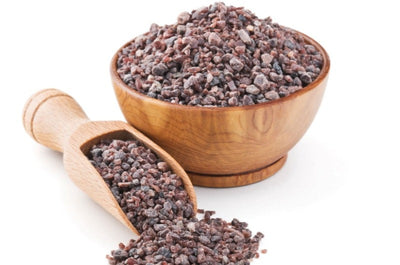


From the above points, it is quite clear that Himalayan pink salt is not the same as Indian black salt in any way despite having properties of minerals and benefits in common.


Buying and Storing Kala Namak
A small packet is enough to get started. There’s little point buying a large bag before you know whether you’ll use it beyond one or two recipes.
Have a look at the ingredients before buying. A packet of kala namak on its own isn’t the same as a seasoning blend that contains it.
Follow the storage instructions and close the packet after use. You can put it in a jar instead, but label the jar clearly and save the original product details.
Fine Salt or Larger Pieces?
For something you can stir straight into food, choose fine kala namak. It’s handy for dips and dressings because there’s no grinding to do first.
Larger pieces need a little more preparation. Crush or grind them before mixing them through a dish where you want the seasoning spread evenly.
Kala Namak: Flavour and Everyday Uses
Kala namak smells and tastes a bit like boiled eggs. You’ll also find it sold as Indian black salt. That might sound unusual for a seasoning, but it explains why some recipes ask for it specifically. Ordinary salt won’t give you that flavour.
There’s no need to replace the salt you normally cook with. Try kala namak in a few dishes and see where you like it.
Adjusting the Salt in a Recipe
Remember to count kala namak as part of the salt you’re adding. Rather than using your usual amount of ordinary salt as well, hold some back and taste the dish.
Check the other ingredients too. Stock and bottled sauces may already contain salt, as can ready-made seasoning mixes.
There isn’t a set amount of kala namak that works for every meal.
Why Kala Namak has a distinctive smell?
Kala Namak occurs from the purification of Himalayan pink salt and other ingredients like activated charcoal and harad herbs.
The heating procedure of Kala Namak gives it its distinctive smell. The charcoal gives it a Sulfurous pungent smell, which also smells like hard-boiled eggs.
Rock salt is beneficial to people habituated with vegan diets. The non-veg people do not need black salt as a smell-adding ingredient, but it is quite challenging for the vegans and vegetarians to engulf their food without any alluring smell.
With its distinctive hard-boiled smell, black salt makes it easier for vegans to survive on vegetarian dishes with egg smell.

How do you use Kala Namak?
Despite knowing the benefits and uses of Kala Namak, some people fail to see the expected results due to the wrong intake.
There are several ways in which you can intake Kala Namak. One of the most common forms of taking Indian black salt is by adding it to the cuisine meals directly while cooking.
You can take a few pinches of Kala Namak and mix it with a dash of lemon juice and a little piece of ginger in the morning for getting the best results.

Where to buy Kala Namak?
If you are searching for Indian black salt now but do not know where to find it, you should know that Asia is the birthplace of Kala Namak.
The most popular places to find Kala Namak are India, Bangladesh, Nepal, and Pakistan. You can easily find original Kala Namak without bits of adulteration from parts of the above countries. You can find it online as well.
The above article can help you with the basic information on Kala Namak or Indian black salt at ease. Go through it to find out now!